Showing posts with label Global Warming. Show all posts
Showing posts with label Global Warming. Show all posts
Friday, May 8, 2015

Wednesday, May 6, 2015
Deforestation
Deforestation

Deforestation is the permanent destruction of forests in order
to make the land available for other uses. An estimated 18 million acres (7.3
million hectares) of forest, which is roughly the size of the country of
Panama, are lost each year, according to the United Nations' Food and
Agriculture Organization. Forests cover 31% of the land area on
our planet. They produce vital oxygen and provide homes for people and
wildlife. Many of the world’s most threatened and endangered animals live in
forests, and 1.6 billion people rely on benefits forests offer, including food,
fresh water, clothing, traditional medicine and shelter. Deforestation
is a major driver of global warming, responsible for up to 20 percent of global
greenhouse gas emissions–more than all the cars, trucks, planes, boats and
trains in the world combined. Deforestation doesn’t just threaten our climate,
it threatens the livelihoods of 1.6 billion people that rely on forests for
food and economic activity. Forests also serve as habitats to rare and
undiscovered animal and plant species and play a key role in providing water
and preventing flooding and erosion.
 Ending deforestation and protecting
forests will not only preserve biodiversity and defend the rights of forest
communities, it is also one of the quickest and cost effective ways of curbing
global warming. But forests around
the world are under threat from deforestation, jeopardizing these benefits.
Deforestation comes in many forms, including fires, clear-cutting for
agriculture, ranching and development, unsustainable logging for timber, and
degradation due to climate change. This impacts people’s livelihoods and
threatens a wide range of plant and animal species. Deforestation can cause the
extinction of many species such as the Giant Panda, Tiger, Gorillas, Asian
Elephant, Rhino, and the Amazon.
Thursday, April 30, 2015
Friday, April 24, 2015
Species Extinction
Species Extinction
Just to illustrate the degree of biodiversity loss we're facing,
let’s take you through one scientific analysis...
 The rapid loss of species we are seeing today is estimated by
experts to be between 1,000 and 10,000 times higher than the natural extinction
rate.*
These experts calculate that between 0.01 and 0.1% of all species
will become extinct each year.
 If the low estimate of the number of species out there is true -
i.e. that there are around 2 million different species on our planet** - then that means between 200 and 2,000
extinctions occur every year.
But if the upper estimate of species numbers is true - that there
are 100 million different species co-existing with us on our planet - then
between 10,000 and 100,000 species are becoming extinct each year.

*Experts actually
call this natural extinction rate the background extinction rate. This simply
means the rate of species extinctions that would occur if we humans were not
around.
** Between 1.4 and 1.8 million species have already been
scientifically identified
Some Animals that are in Danger
of Extinction
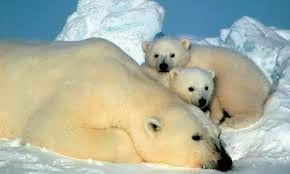
 Polar Bears
Tigers
Elephants
Rhinos
Gorilla
Giant Panda
Marine Turtle
Wednesday, April 22, 2015
Global Warming
Climate
Changes Affecting The Public Health
Climate
change is one of the most serious public health threats facing the nation, but
few people are aware of how it can affect them. Children, the elderly, and
communities living in poverty are among the most vulnerable. Climate change
will worsen smog and causes plants to produce more pollen pollution, increasing
respiratory health threats, particularly for people with allergies and asthma.

Most
climate scientists agree the main cause of the current global warming trend is
human expansion of the "greenhouse effect"1 — warming that results
when the atmosphere traps heat radiating from Earth toward space.Certain gases
in the atmosphere block heat from escaping. Long-lived gases that remain
semi-permanently in the atmosphere and do not respond physically or chemically
to changes in temperature are described as "forcing" climate change.
Gases, such as water vapor, which respond physically or chemically to changes
in temperature are seen as "feedbacks."

Subscribe to:
Posts (Atom)